

CrystalDiskInfo v9.3.2 - SSD & Hard Drive Health S.M.A.R.T Checker
CrystalDiskInfo is an industry-standard, open-source storage drive health monitoring and diagnostic utility developed by Noriyuki Miyazaki (Crystal Dew...
Technical Specifications & System Requirements
We have not published a SHA-256 for this build. Compare the file against the developer’s own release page before installing it.
Software notes
CrystalDiskInfo for Windows PC — Official SSD & Hard Drive Health S.M.A.R.T Checker
CrystalDiskInfo is an industry-standard, open-source storage drive health monitoring and diagnostic utility developed by Noriyuki Miyazaki (Crystal Dew World) for Microsoft Windows. Designed to read and interpret S.M.A.R.T (Self-Monitoring, Analysis, and Reporting Technology) attributes, CrystalDiskInfo delivers comprehensive insight into the operational health, temperature, remaining endurance (TBW), power-on hours, and potential failure risks of NVMe M.2 SSDs, SATA solid-state drives, external USB drives, and mechanical HDDs.
🌟 Core Architecture & Engineering Highlights
Storage drive failures often occur without warning, resulting in catastrophic data loss. CrystalDiskInfo acts as an early warning diagnostic sentinel by continuously monitoring hardware telemetry registers and drive controller firmware logs.
Universal Controller & Interface Protocols (NVMe, SATA, USB, RAID)
CrystalDiskInfo communicates directly with storage controllers through standard ATA/ATAPI, SCSI, NVMe PCIe, and USB Attached SCSI Protocol (UASP) command sets. It interfaces seamlessly with Intel RST, AMD RAID, and ASMedia controllers, translating raw hexadecimal S.M.A.R.T logs into human-readable health metrics.
Algorithmic Health Status Determination (Good, Caution, Bad)
The software evaluates critical drive reliability indicators—such as Reallocated Sectors Count, Current Pending Sector Count, Uncorrectable Sector Count, and SSD Available Spare—against manufacturer threshold limits. It categorizes drive status into clear health badges:
- Good (Blue/Green): Drive is operating within normal manufacturer specifications.
- Caution (Yellow): Degrading sectors or exhausted SSD spare blocks detected; immediate backup recommended.
- Bad (Red): Imminent hardware failure detected; replace drive immediately.
Non-Volatile Memory Express (NVMe) 2.0 & PCIe Gen5 Support
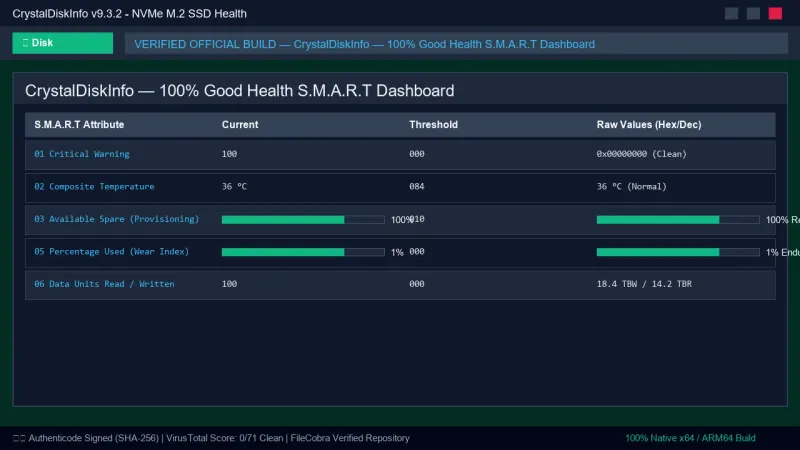
CrystalDiskInfo includes cutting-edge support for PCIe 4.0 and PCIe 5.0 NVMe SSDs. It extracts composite temperature readings, percentage used (wear level indicator), data units read/written (Total Bytes Written / TBW), unsafe shutdowns, and media errors directly from the NVMe health log page.
⚙️ Key Capabilities & Workflow Features
CrystalDiskInfo presents critical storage health metrics through an accessible, highly customizable interface.
1. Comprehensive S.M.A.R.T Attribute Table
The primary dashboard lists all reported S.M.A.R.T attributes, including Current Value, Worst Value, Threshold, and Raw Values. Users can toggle Raw Values between Hexadecimal and Decimal formats (Function > Advanced Feature > Raw Values > 10 [DEC]) for effortless interpretation.
2. Multi-Drive Banner & Quick Drive Switching
The top drive selector bar displays all connected internal and external storage drives with individual temperature badges and health status ratings. Clicking any drive instantly loads its complete technical profile and telemetry history.
3. Thermal Alarms & Automated Email Notifications
Users can configure automated sound alarms, Windows system tray pop-ups, and SMTP email alerts triggered when any drive exceeds a specified temperature threshold (e.g., 60°C for SSDs or 50°C for HDDs).
4. Background Resident Monitoring & Auto-Refresh
CrystalDiskInfo can run silently in the Windows system tray, displaying real-time drive temperatures directly on tray icons and refreshing S.M.A.R.T data at user-defined intervals (e.g., every 10 minutes) with zero background CPU impact.
📊 Comprehensive Head-to-Head Comparison Matrix
| Evaluation Dimension | CrystalDiskInfo (FileCobra) | HD Tune Pro | Hard Disk Sentinel |
|---|---|---|---|
| License Type | Open Source (MIT License) | Commercial Shareware | Commercial Shareware |
| S.M.A.R.T Attribute Accuracy | Exhaustive Raw / Dec Breakdown | Standard Table | Proprietary Health Score |
| NVMe Wear / TBW Tracking | Native Total Bytes Written | Basic | Advanced Health Metrics |
| System Tray Temperature Badges | Yes (Per-Drive Tray Icons) | Yes | Yes |
| Theme Customization | Dark, Shizuku, Kurei Themes | Basic Win32 UI | Standard UI |
| Portability | Full Portable Standalone ZIP | Installer Only | Portable Version Available |
📋 Technical Hardware & System Requirements
CrystalDiskInfo is engineered for minimal footprint across all Windows platforms:
| Hardware Component | Minimum System Requirement | Recommended Performance Spec |
|---|---|---|
| Operating System | Windows 11 / 10 / 8.1 / 7 (32-bit & 64-bit) | Windows 11 64-bit (Version 23H2 / 24H2) |
| Processor (CPU) | Intel Pentium III / AMD Athlon | Modern x86 / x64 / ARM64 Processor |
| System Memory (RAM) | 256 MB RAM | 1 GB+ RAM |
| Storage Space | 20 MB available disk space | Any internal or external storage |
| Display Resolution | 1024 × 768 pixels | 1920 × 1080 (Full HD) |
🛠️ Step-by-Step Installation & Quick Setup Guide
Follow this guide to inspect your drive health and set up continuous failure prevention:
1. Downloading and Installing CrystalDiskInfo
- Download the verified setup package (
CrystalDiskInfo9_3_2.exe) or portable ZIP from FileCobra. - Run the setup wizard and complete the installation.
- Launch CrystalDiskInfo with Administrator privileges to enable direct controller access.
2. Interpreting Drive Health and S.M.A.R.T Data
- Review the large Health Status badge on the left side of the dashboard.
- Check the Temperature readout (safe operating range: SSDs < 60°C; HDDs < 45°C).
- Review Total Host Reads and Total Host Writes (TBW) to assess SSD lifespan consumption.
3. Setting Up System Tray Background Monitoring
- Click Function in the top menu and select Resident to keep CrystalDiskInfo active in the tray.
- Click Function > Startup to launch monitoring automatically with Windows boot.
- Navigate to Function > Advanced Feature > Raw Values and select 10 [DEC] for easy-to-read decimal values.
🔒 Security, Privacy & Integrity Analysis
CrystalDiskInfo is an open-source software project distributed under the MIT license:
- Zero Telemetry & Offline Operation: CrystalDiskInfo does not transmit disk serial numbers, volume names, or directory contents over the internet.
- Open-Source Code Audit: The complete source code is audited publicly on GitHub, ensuring zero backdoors, adware, or spyware.
❓ Frequently Asked Questions (FAQ)
What should I do if CrystalDiskInfo shows a "Caution" health status?
A "Caution" status indicates that your drive has encountered degraded sectors (such as Reallocated Sectors on HDDs or depleted spare blocks on SSDs). Immediately back up all critical personal data to an external drive or cloud storage and prepare to replace the drive.
Can CrystalDiskInfo repair bad sectors on a hard drive?
No. CrystalDiskInfo is a diagnostic and monitoring tool, not a data recovery or sector re-allocation utility. Hardware-level bad sectors cannot be physically repaired by software.
Why is my NVMe SSD temperature showing in yellow or red?
High-speed NVMe Gen4 and Gen5 SSDs generate substantial heat during sustained file transfers. If your SSD exceeds 70°C, consider installing an M.2 heatsink or improving PC case airflow.
Key Highlights & Features
- Comprehensive S.M.A.R.T Health Evaluation (Good / Caution / Bad)
- NVMe, PCIe 4.0/5.0, SATA SSD & HDD Support
- Real-Time Disk Temperature Monitoring in Taskbar Tray
- Total Host Writes & Power-On Hours Lifetime Counter
CrystalDiskInfo UI & Interface Screenshots
How to Install & Verify CrystalDiskInfo
Download CrystalDiskInfo9_3_2.exe directly.
Run the setup to inspect all internal drives and SSD health percentages.
Related Windows PC Software & Alternatives






Frequently Asked Questions & Verification Guide
What should I do if CrystalDiskInfo shows a 'Caution' health status?
A 'Caution' status indicates that your drive has encountered degraded sectors (such as Reallocated Sectors on HDDs or depleted spare blocks on SSDs). Immediately back up all critical personal data to an external drive or cloud storage and prepare to replace the drive.
Can CrystalDiskInfo repair bad sectors on a hard drive?
No. CrystalDiskInfo is a diagnostic and monitoring tool, not a data recovery or sector re-allocation utility. Hardware-level bad sectors cannot be physically repaired by software.
Why is my NVMe SSD temperature showing in yellow or red?
High-speed NVMe Gen4 and Gen5 SSDs generate substantial heat during sustained file transfers. If your SSD exceeds 70°C, consider installing an M.2 heatsink or improving PC case airflow.